 Blueshift
 Auto HODL stakers forfeit locked rewards when they exit early
- updated
Blueshift's Auto HODL design combines BLUES staking with automatic compounding, while an early exit forfeits the holder's locked rewards. Remaining stakers can benefit from those forfeited rewards under the pool's HODL conditions. Staking duration and other participants' exits affect the reward outcome, with larger HODL payouts linked to total value locked (TVL) goals. Automatic reward reinvestment and access to locked HODL rewards follow separate rules.
The short version: Manual harvesting incurs a transaction fee, which differs from the locked-reward forfeiture that applies to an early Auto HODL exit.
BLUES staking and portfolio shares
Auto HODL accepts a BLUES stake, which differs from the LP tokens used in liquidity-provider farming. Portfolio LP tokens represent a share of pooled assets. Staking those LP tokens in a farm can earn BLUES rewards, connecting the activities through their reward asset. Auto HODL then applies its own rules when a participant stakes BLUES in the yield pool. A portfolio share and a BLUES staking position remain separate holdings.
Automatic reinvestment within the stake
Automatic compounding reinvests earned BLUES in the staking pool, increasing the token amount that can earn subsequent rewards. The pool handles that reinvestment without requiring a separate manual harvest for each reward. It doesn't remove the HODL conditions that govern access to locked rewards.
The holder decides whether to remain staked.
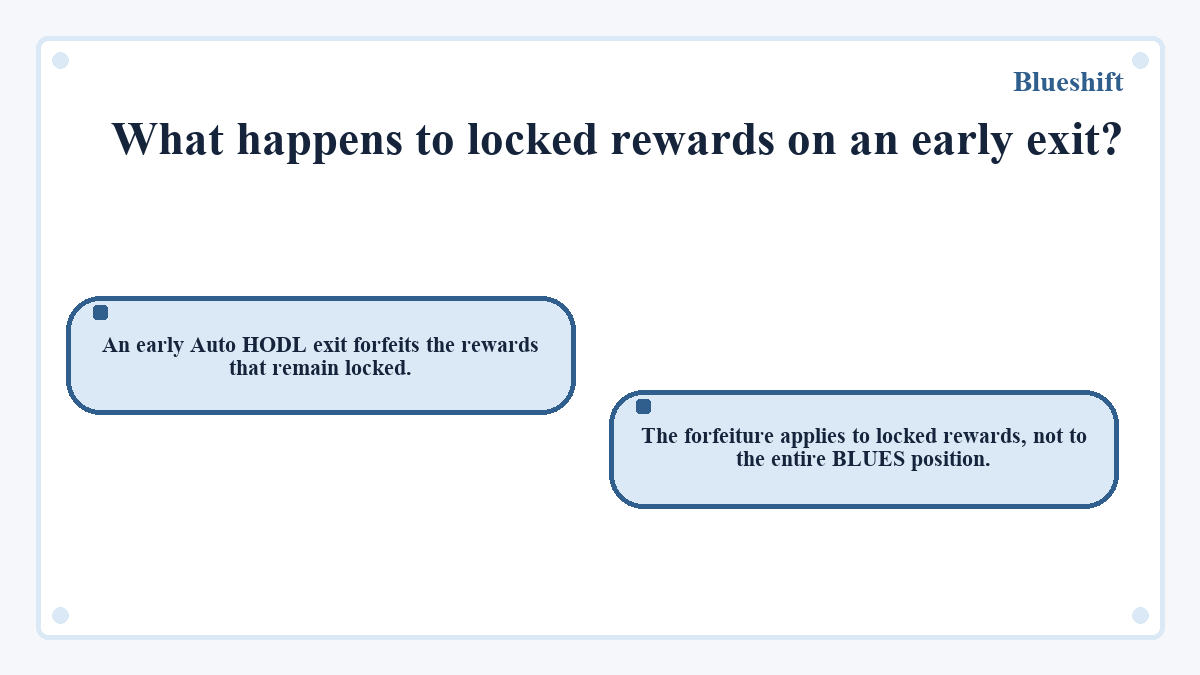
What happens to locked rewards on an early exit?
An early Auto HODL exit forfeits the rewards that remain locked. The forfeiture applies to locked rewards, not to the entire BLUES position.
HODL rewards for participants who remain
Remaining stakers can benefit from rewards that early leavers forfeit, linking their outcome to other participants' withdrawal decisions. That additional HODL component differs from ordinary reward reinvestment. Compounding puts earned rewards back into a stake; redistribution changes who benefits from locked rewards after another participant exits.
The Auto HODL model also links larger HODL payouts to TVL goals. TVL means total value locked. Staking duration affects rewards, too, but elapsed time and a TVL target measure different things. A fixed waiting period shouldn't replace the applicable reward condition when interpreting an expected payout.
Manual harvesting and its transaction fee
The Manual pool accumulates rewards separately and lets the holder harvest them without Auto HODL's early-withdrawal penalty. It doesn't compound rewards automatically. A harvest requires the holder's action and incurs a transaction fee, so access and reinvestment follow different arrangements in the two pool types.
That transaction fee and Auto HODL's locked-reward forfeiture describe different costs. One accompanies a Manual harvest; the other gives up a conditional reward entitlement on an early Auto HODL exit. The choice turns on when the holder needs access to rewards and whether automatic reinvestment suits that need.
Equal accrued rewards with different exit outcomes
For this hypothetical comparison, assume an initial stake of 824 BLUES and 34 BLUES of accrued rewards in each documented pool design. In the Auto HODL case, all 34 reward tokens remain locked when the holder wants to exit.
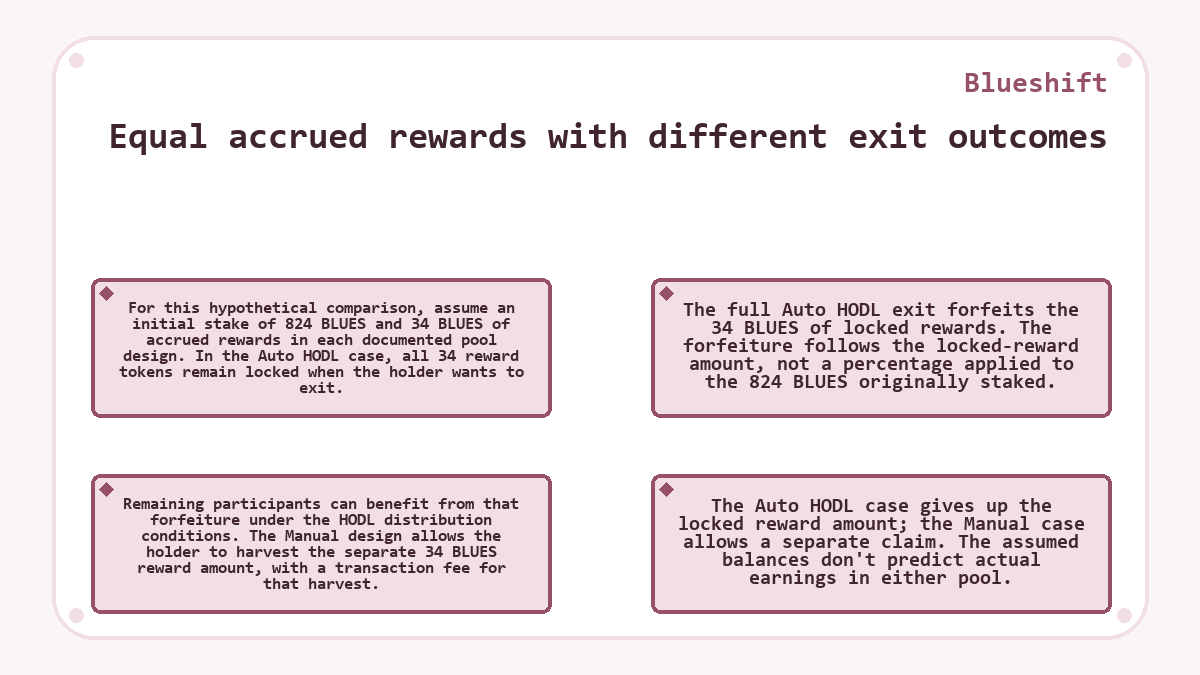
The full Auto HODL exit forfeits the 34 BLUES of locked rewards. The forfeiture follows the locked-reward amount, not a percentage applied to the 824 BLUES originally staked. Remaining participants can benefit from that forfeiture under the HODL distribution conditions.
The Manual design allows the holder to harvest the separate 34 BLUES reward amount, with a transaction fee for that harvest. The Auto HODL case gives up the locked reward amount; the Manual case allows a separate claim. The assumed balances don't predict actual earnings in either pool.
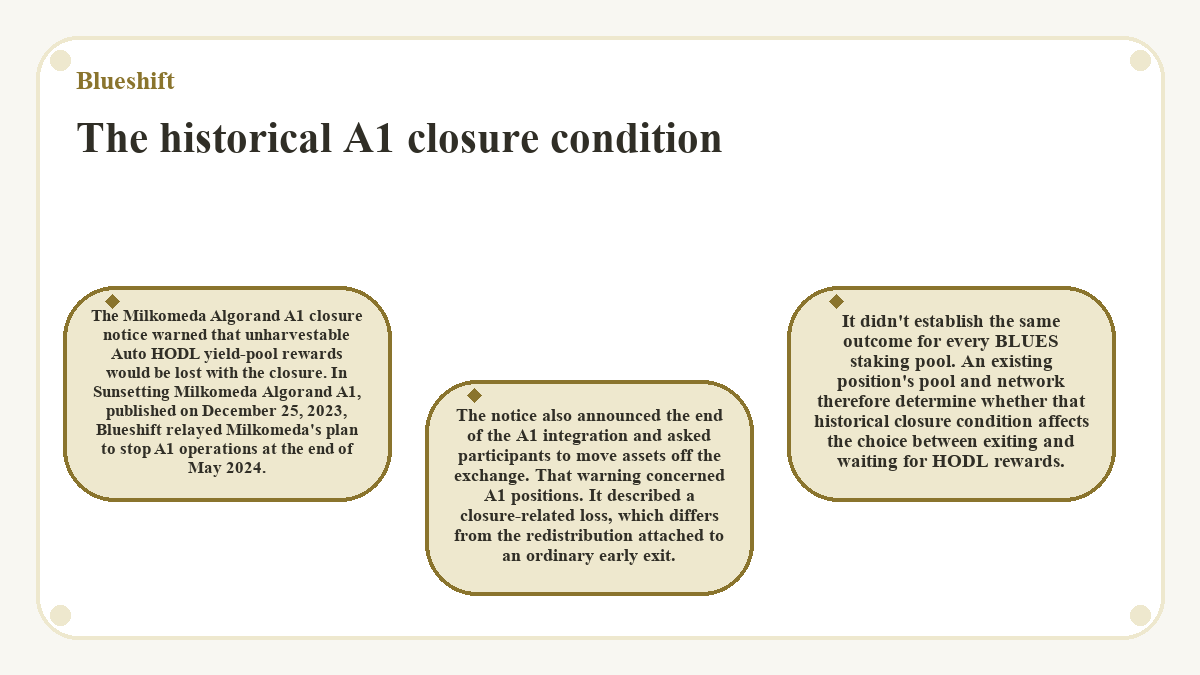
The historical A1 closure condition
The Milkomeda Algorand A1 closure notice warned that unharvestable Auto HODL yield-pool rewards would be lost with the closure. In Sunsetting Milkomeda Algorand A1, published on December 25, 2023, Blueshift relayed Milkomeda's plan to stop A1 operations at the end of May 2024. The notice also announced the end of the A1 integration and asked participants to move assets off the exchange.
That warning concerned A1 positions. It described a closure-related loss, which differs from the redistribution attached to an ordinary early exit. It didn't establish the same outcome for every BLUES staking pool. An existing position's pool and network therefore determine whether that historical closure condition affects the choice between exiting and waiting for HODL rewards.
Practical questions about Blueshift
How often are Auto HODL rewards compounded?
The Auto HODL design described on December 15, 2023, reinvests rewards several times a day. That cadence concerns reinvestment within the pool. It doesn't set an equally frequent withdrawal schedule or release rewards that remain locked.
Can BLUES holdings be split between Auto HODL and Manual?
The documented yield-pool model allows a holder to allocate BLUES across Auto HODL and Manual. Each allocation follows its own pool's reward handling and exit conditions. The Manual allocation doesn't remove the forfeiture condition from an Auto HODL stake, and the Auto HODL allocation doesn't add automatic compounding to the Manual position.
Does automatic compounding guarantee a higher dollar value?
Automatic compounding reinvests BLUES rewards without fixing the dollar price of BLUES. A larger token amount and a larger dollar value are different outcomes. The token's price affects the latter, while locked rewards add a separate restriction on access. A compounded balance therefore doesn't establish a fixed dollar gain or the amount immediately available for withdrawal.
Are Auto HODL rewards the same as portfolio trading fees?
Auto HODL rewards concern BLUES yield-pool staking, while portfolio trading fees accrue to LP-token holders from swaps. The two positions have different underlying assets and reward mechanisms. A participant can receive portfolio fees without that portfolio share becoming an Auto HODL stake. Farming adds another connection by distributing BLUES to LP-token stakers, but the yield pool remains a separate position.