 Blueshift
 liquidity portfolios and your first LP share
- updated
Blueshift liquidity portfolios turn deposits of supported tokens into LP tokens that represent a share of the portfolio's combined assets. You can contribute one accepted token or several, while your exposure follows the whole basket. Each portfolio has its own asset weights, which influence deposit allocation and withdrawal choices. A deposit can create price impact when it pushes a token above its target share. For a first deposit, understanding the basket matters as much as choosing the token that funds it. The proposed allocation shows what the deposit would contribute. A completed deposit returns share tokens, while a later withdrawal exchanges those tokens for available portfolio assets.
Key takeaway: Withdrawing a token whose portfolio weight would fall below target can create price impact, even if it originally funded the deposit.
The share behind a single-token contribution
A single-token contribution buys exposure to the selected portfolio's assets through the LP tokens that the deposit returns. LP means liquidity provider. The portfolio holds the assets, while its LP token represents your share. The input token determines what you contribute, while the basket determines the assets underlying that position.
Trading changes the tokens held within the portfolio, so the composition behind an LP position can vary over time. Holding the share doesn't reserve the original deposit tokens for a later return. Changes in the basket's asset prices also affect the position's value. Income from trading fees doesn't fix that value.
Temporary trading pairs inside the portfolio
Blueshift creates temporary virtual pairs from portfolio liquidity when it needs to exchange tokens within that portfolio. The pair supplies the pricing relationship for a swap without becoming a permanent pool alongside the basket. After the swap, the protocol removes the virtual pair and stores the resulting price in its internal oracle. This connects individual trades to the shared reserves whose changing composition underlies the LP position.
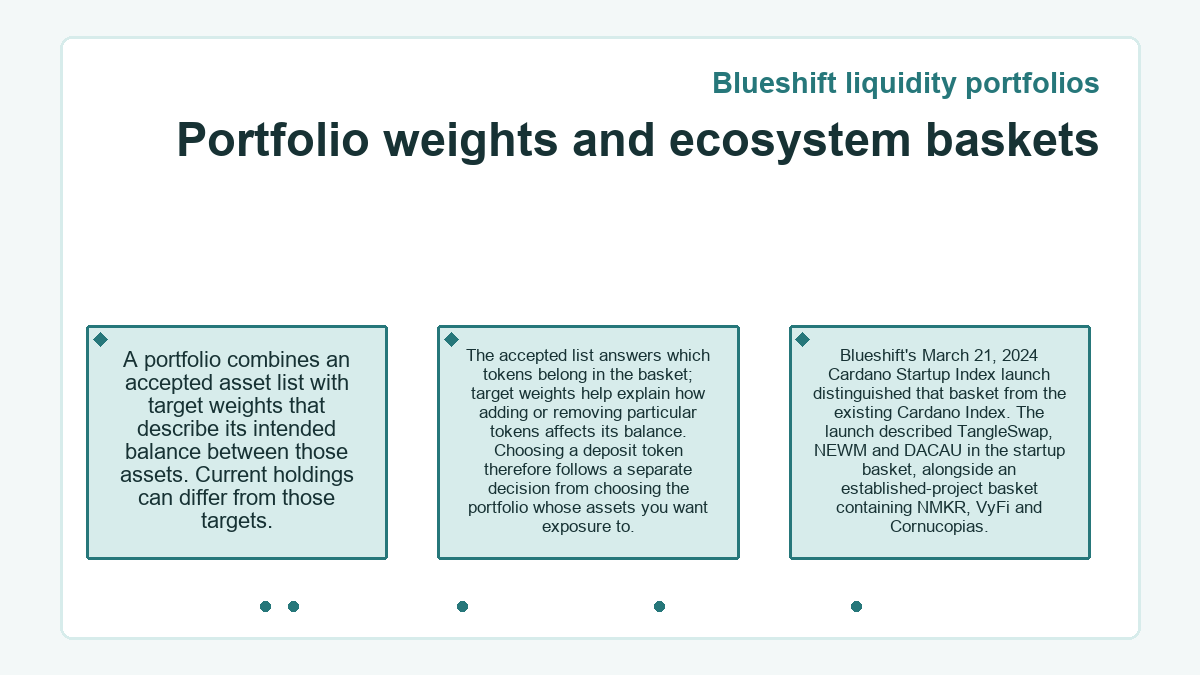
Portfolio weights and ecosystem baskets
A portfolio combines an accepted asset list with target weights that describe its intended balance between those assets. Current holdings can differ from those targets. The accepted list answers which tokens belong in the basket; target weights help explain how adding or removing particular tokens affects its balance. Choosing a deposit token therefore follows a separate decision from choosing the portfolio whose assets you want exposure to.
Blueshift's March 21, 2024 Cardano Startup Index launch distinguished that basket from the existing Cardano Index. The launch described TangleSwap, NEWM and DACAU in the startup basket, alongside an established-project basket containing NMKR, VyFi and Cornucopias.
Why can a single-token deposit have price impact?
A single-token deposit can create price impact when it increases that token's share beyond the portfolio's target weight. Contributing several tokens gives the allocation algorithm more inputs to work with. The outcome still depends on the selected assets, wallet balances and existing portfolio composition.
Allocation settings
Within wallet balances
The "Provide within balances" mode constrains the proposed allocation to the selected tokens already available in the wallet. The algorithm distributes the requested contribution across those balances while trying to minimize price impact.
Without the balance constraint
Turning off "Provide within balances" shows which selected tokens and amounts would support the proposed deposit without the wallet-balance restriction. A displayed allocation doesn't establish that those amounts are already available to spend.
Token priority
The token order expresses a preference: a higher position gives that token greater deposit priority. Reordering doesn't always change the allocation because the lowest-impact distribution can remain the same. The portfolio's token shares affect the calculation. Wallet balances constrain it when "Provide within balances" is enabled.
Changing the funding mix can change entry price impact without changing which portfolio the LP tokens represent.
A first deposit with a clear stopping point
A first deposit starts with the question of whether the available tokens can fund a portfolio whose full basket you want to hold. Single-token funding offers one input; selecting several accepted tokens gives the allocator more choices. Either route creates the same kind of portfolio share.
- On the selected application network, choose an available portfolio whose full asset list matches the exposure you intend to hold.
- Select an accepted deposit token on the portfolio's application network.
- Keep "Provide within balances" enabled when the proposed contribution must fit existing wallet holdings.
- Review the token amounts and price impact before authorizing spending.
- Keep LP farming outside the first deposit if the intended stopping point is an unstaked portfolio share.
In the documented Portfolios interface, "Manage" opens the selected portfolio's controls. "Add liquidity" then allows the deposit amount, token selection and priorities to be set. Reviewing that allocation provides a stopping point before any wallet confirmation.
The wallet may request token-access approval where the selected assets need it. Granting that permission doesn't produce LP tokens.
Blueshift Liquidity Portfolios - Your First Deposit
- Temporary trading pairs inside the portfolio
- Portfolio weights and ecosystem baskets
- Why can a single-token deposit have price impact?
- A first deposit with a clear stopping point
After reviewing the confirmation window, the deposit itself requires wallet confirmation. A completed deposit returns the portfolio's LP tokens, which provide evidence of the acquired share. If the allocation doesn't fit the available assets or acceptable price impact, stop before confirming the deposit.
What determines the tokens available for withdrawal?
Withdrawal choices depend on the portfolio's assets and how the requested amounts would affect their weights relative to target. A withdrawal burns LP tokens in exchange for assets from the portfolio to which those tokens belong. The withdrawal interface supports one token or a combination from that basket.
Removing an asset so that its share falls below target can create price impact. Other available tokens may allow an allocation with less impact. That is why choosing the original deposit token doesn't establish an equally favorable withdrawal. The interface's suggested distribution reflects the basket at withdrawal time, including changes since entry.
LP tokens staked in a farm must first return to the wallet balance through unstaking. Only the amount needed for the intended withdrawal has to leave the farm.
Trading fees and optional LP farming
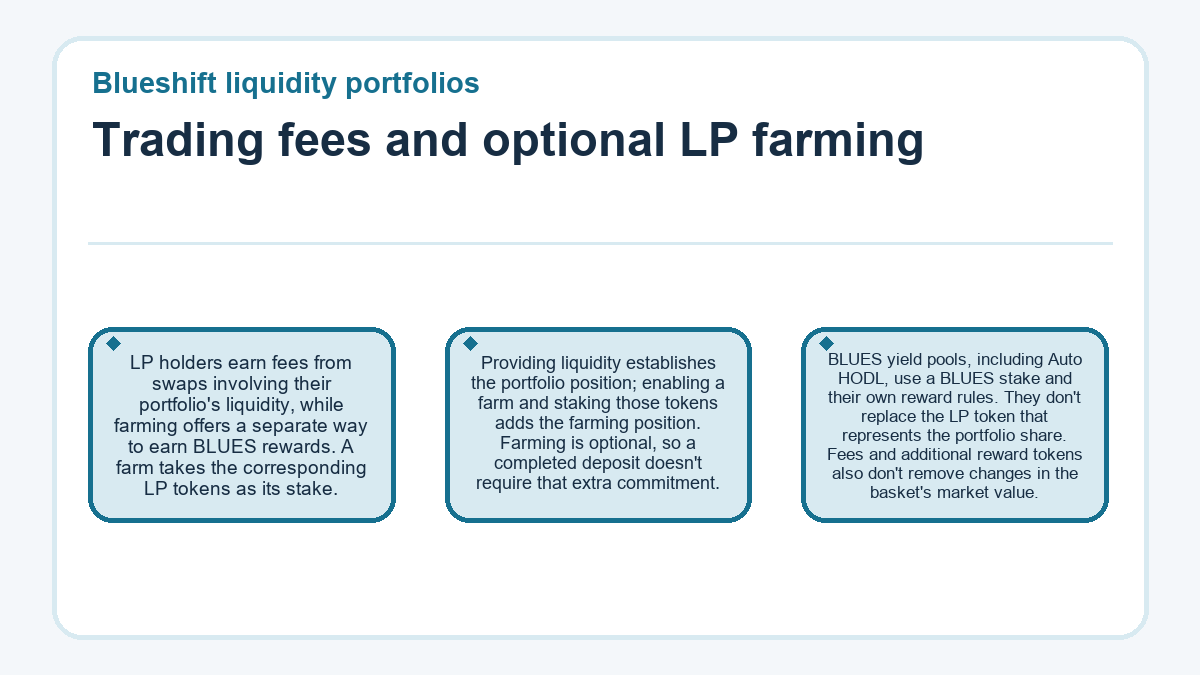
LP holders earn fees from swaps involving their portfolio's liquidity, while farming offers a separate way to earn BLUES rewards. A farm takes the corresponding LP tokens as its stake. Providing liquidity establishes the portfolio position; enabling a farm and staking those tokens adds the farming position. Farming is optional, so a completed deposit doesn't require that extra commitment.
BLUES yield pools, including Auto HODL, use a BLUES stake and their own reward rules. They don't replace the LP token that represents the portfolio share. Fees and additional reward tokens also don't remove changes in the basket's market value.
Older instructions and the network boundary
A portfolio deposit requires an available portfolio on the selected network, so historical interface instructions need their original network context. Blueshift's December 25, 2023 notice, "Sunsetting Milkomeda Algorand A1," announced the end of its A1 integration. It described the chain operator's planned end of operations at the end of May 2024. That announcement concerned Algorand A1 and didn't announce the closure of every Blueshift deployment.
A1-era walkthroughs describe that historical integration. Their continued presence doesn't establish an available deposit route today; the deposit instructions apply only where the relevant network, portfolio and interface remain available.
Blueshift liquidity portfolios: what people ask
Does entering a deposit value in USD mean I am depositing dollars?
Entering a value in USD sets the contribution's denomination; the selected portfolio tokens fund the deposit. The documented form also permits an amount expressed in BASE currency. Read the resulting token allocation to understand which assets the transaction would spend. A currency-denominated amount doesn't replace the requirement to hold the selected deposit assets.
Who controls the list of tokens that a portfolio accepts?
Blueshift's portfolio design assigns management of accepted token lists to the protocol's user community. An individual deposit's token selection chooses funding from the assets that the portfolio accepts. It doesn't define a new basket or establish its membership.
Can the withdrawal amount be specified in LP tokens?
The documented withdrawal form accepts an LP token amount as an alternative to a value in USD. That amount identifies the share tokens to redeem. The separate token selection determines which portfolio assets the withdrawal requests. Entering an LP amount therefore doesn't promise a particular quantity of the token that originally funded the position.
Is a farm multiplier a fixed percentage return?
A farm multiplier specifies relative BLUES reward allocation across farms, not a fixed percentage gain on a deposit. A multiplier of four describes four times the BLUES distribution of a multiplier of one. That ratio concerns the farm's rewards; it doesn't determine the value of the assets represented by an individual LP token balance.
What does the 2022 CertiK audit establish about a portfolio deposit?
The CertiK audit assesses the contracts and files within its review scope. Its Blueshift audit timeline includes a revision dated May 2, 2022. That dated review doesn't establish coverage for every later deployment or code update. It also doesn't establish a portfolio share's future value or remove price impact from a deposit.